
What Is Matrescence? The Complete Guide to the Motherhood Identity Shift
- Words Lauren Smith-Pierson
- Season Spring · The Crossing
- Read time 31 min
- Last updated March 2026
Matrescence is the physical, emotional, and identity-level transformation of becoming a mother. Learn what it is, what it feels like, and what to do about it from a certified matrescence coach.
In This Guide
- Matrescence, Defined
- Why Have You Never Heard the Word Matrescence Before?
- What Matrescence Actually Feels Like
- What Actually Changes During Matrescence?
- Is What I'm Feeling Matrescence — or Is It Something More Serious?
- Why Does Becoming a Mother Feel Like Losing Yourself?
- How Long Does Matrescence Last?
- Matrescence Is Not a Problem to Solve
- So — What Do We Actually Do With All of This?
- Where Do You Start?
- Frequently Asked Questions About Matrescence
What Is Matrescence? The Complete Guide to the Motherhood Identity Shift
Last updated: March 2026 | Written by Lauren Smith-Pierson, ICF Certified Matrescence Coach, Founder, simplymatrescence.com
I was at a local supper club event with my husband and we sat across from a couple with a 4 month old baby new to town. As the small talk started to deepen, the new mom and I quickly fell into a rhythm and out came the common refrain… I really can't believe we're expected to do this alone. I nodded my head. I asked her if she'd heard the term "matrescence." And in fact, she had. She had just come across it a few months into her motherhood journey and it made so much sense to her. I tell this story, because it was a real-life signal that the term matrescence is finally entering the modern lexicon.
In 2020, I shifted the focus of my coaching practice to support women as they navigate their own matrescence because I could feel the need deep in my bones. That was six years ago, and every time I shared what I did with someone who wasn't a birth practitioner, the word "matrescence" resulted in a blank stare. Here we are six years later, and there are a few more head nods than blank stares.
If you've been seeing the word "matrescence" everywhere lately — in your feed or from a friend — and you felt something resonate, then tuck in, because you're in for a big shift. And this guide will break it all down. But before we start, I'll begin with the most important reframe every new mom needs to hear:
You're not falling apart. You're not failing. And you're almost certainly not the only one who has lain awake at 3am wondering: who am I? Why didn't anyone warn me about this?
There's actually a word for what you're going through.
I came across the word "matrescence" a few months after my first daughter was born, wandering my neighborhood in the thick of newborn fog. I was listening to a podcast by Amy Taylor-Kabbaz, and something settled in me. For the first time, I had a different way to perceive all the changes that were taking place in my life, from the deeply uncomfortable unraveling to the overwhelming expansion in my heart.
Oh. There is something going on here. It's not just me.
I'm a certified matrescence coach, and that moment — the word landing — is where almost every conversation I have with a mother begins. That recognition. A sigh of relief from being seen. That reorientation from what is wrong with me to oh — I'm going through something.
That shift changes everything. And it's what this work is built on.
If you're short on time, here's what matters:
Key facts about matrescence:
- Coined by medical anthropologist Dana Raphael in 1973 — over fifty years ago
- Brought into modern academic discourse by Dr. Aurelie Athan (Columbia University) and clinical practice by Dr. Alexandra Sacks (TED Talk, clinical writing)
- Universal — every woman who becomes a mother, including non-birthing mothers, experiences some form of matrescence even while it takes a unique shape with each person
- As significant as adolescence in its broad sphere of changes: matrescence encompasses changes in multiple domains — biological, emotional, psychological, social, political, and even spiritual. It even produces brain changes comparable in scope to puberty (Hoekzema et al., 2017)
- A years-long process — not a phase that ends at six weeks or three months
- Distinct from postpartum depression or other perinatal mental health disorders, though the two can co-occur (PPD affects ~1 in 5 mothers)
- Still new to the modern lexicon — 67% of mothers have never heard the word (Peanut/Tommee Tippee survey, 2026)
Matrescence, Defined
Matrescence is the profound psychological, biological, cultural, social, spiritual and identity-level transition a woman undergoes when she becomes a mother — as significant as adolescence, but almost entirely unrecognized by modern mainstream culture.
The term was coined by medical anthropologist Dana Raphael in 1973 — the same woman who gave us the word "doula." Dr. Aurelie Athan at Columbia University built the modern academic framework, establishing matrescence as a developmental stage comparable to adolescence. And Dr. Alexandra Sacks brought it into clinical practice and public awareness through her writing and TED Talk, which introduced the concept to a generation of mothers who had been waiting for exactly this language without knowing it.

Think of it as the adult equivalent of adolescence. When teenagers go through puberty, we expect them to be confused, emotional, moody, and deeply preoccupied with who they are becoming. We give that transition a name, a cultural framework, and a lot of patience. When women become mothers, we make sure they have the stuff they need from their registry, support them through birth, but then expect them to figure the rest out alone alongside the pressure to "bounce back" to their pre-mother self.
Matrescence gives us the language to say: this is a developmental passage, not a personal failing. It is as significant as adolescence, it touches every area of your life, and it deserves to be witnessed, honored, and given weight by the mother herself, the people in her life, and society as a whole.
Here's what you need to know:
- Universal — every woman who becomes a mother experiences some form of matrescence
- As significant as adolescence in scope — touching physical, emotional, identity, social, cultural, economic, and spiritual domains
- A years-long process — not a postpartum phase that ends at six weeks or three months. For many, it feels like a lifelong process as you move through different seasons of motherhood.
- Distinct from postpartum depression or other perinatal mood disorders, though the two can occur simultaneously
- Recurs with each child
In February 2026, motherhood brands Peanut and Tommee Tippee created a campaign that brought this word into mainstream conversation — their research found that 67% of mothers had never heard the term matrescence (Peanut/Tommee Tippee, 2026). Searches for "what is matrescence" surged over 5,000% in the weeks following the campaign. The word is finally "arriving". But the experience it names has always been here, waiting for language.
Join Lauren's weekly newsletter, Matrescence Missives where she writes from the middle of her own becoming. Essays and curated resources on matrescence, parenting, creativity, and solopreneurship.
Why Have You Never Heard the Word Matrescence Before?
Because maternal experience has been historically underfunded, understudied, and culturally minimized. That's why.
Dana Raphael first used the word in 1973. That is over fifty years ago. And yet if you are reading this article, there is a reasonable chance you have only just encountered it.
This is not an accident. The work of caring for children has long been treated as instinct rather than an experiential transformation — something women simply do, rather than something profound that happens to them. Even within medicine and psychology, the focus has been overwhelmingly on the baby's development, not the mother's.
Dr. Alexandra Sacks spent years in clinical practice before naming this gap publicly. The response was overwhelming — women writing from every corner of the world saying variations of the same thing: I thought something was wrong with me.
Lucy Jones, in her landmark book Matrescence, draws on the feminist writer Adrienne Rich to name something that runs underneath all of this: the "institution of motherhood." Not motherhood itself — the love, the care, the profound relationship — but the sociocultural framework that has grown up around it, with its own rules, standards, and unspoken expectations about what a mother should be. Jones argues that much of what women experience as personal failure during matrescence is in fact the predictable outcome of being measured against an institution that was never designed with the mother's own flourishing in mind.
This is also why the word matrescence matters beyond individual comfort. It shifts the question from "What is wrong with me?" to "What has this culture asked of mothers while ignoring maternal wellbeing?"
That is a very different question. And a conversation I hope will continue.
We've been mothering in the dark, without language, without a framework, and without the cultural acknowledgment that this is one of life's most significant transitions. But now that you know you are not broken — rather, you're going through a profound change — this is where we begin.
What Matrescence Actually Feels Like
Story time.
My first daughter was turning two. My second child was arriving any moment. I was heavily pregnant, still masked and socially distanced living through the second wave of the COVID pandemic, chasing a toddler, working full-time, and trying to hold together all the pieces of life that were about to double in complexity.
We could finally have an actual birthday party, with live people!, and I was determined to give her the cake of my Pinterest's dreams. Made from scratch, no added sugar, but still beautiful, elaborate and designed for all the praise.
I have time. I'm still this mom. I'm about to have a new human to pay attention to, so if I'm going to still be the best mom to my toddler, I need to make this cake. I will make this cake.
Two meltdowns later (from me, not my toddler), I walked to my mom's house, sobbing, and handed her a box of Funfetti cake mix. I couldn't get the words out right away. Finally: "Okay. Make her the box cake. I can't do this."
At the time, handing over that box felt like defeat. One more gap between the mother I wanted to be and the mother I actually was. What I didn't have yet was the language to understand what was really happening: I was still trying to perform as the pre-mother version of myself — the one who accomplished everything on her list, who rarely asked for help, who had it figured out and impressed everyone along the way — while simultaneously becoming someone entirely different.
My girls are now four and six. Of course the box cake didn't matter.
But it's easy to just write that moment off as a new mom rookie mistake (focusing too much on the not-so-important thing), but it's actually more than that.
I look back at that moment with a new level of understanding for that version of me deep in her own matrescence, who didn't yet have the language or tools to navigate those seemingly mundane but crunchy life moments with grace and self compassion, knowing that she was indeed in the depths of a profound and all-encompassing transformation.
In my years working alongside mothers — across 1:1 coaching, group cohorts, and inside a community of over 1,000 new mothers — I can tell you that this experience is not unique to me. The details change, but the themes are remarkably consistent. Here's what I hear, again and again:
The disorientation. I'm here but I'm not here. You're standing in your own kitchen, holding your baby, and something about the scene feels two degrees off-center. You recognize the room but not quite the woman in it.
The grief sitting alongside the love. You can love your baby with a fierceness that surprises you and still mourn the woman you were before. Both can exist. Both do exist. Our culture is very comfortable with the expansion part. What we don't have language for is the loss.
The career identity crisis nobody warned you about. You spent years building something — a reputation, a trajectory, a version of yourself that knew exactly what she was working toward. And now you're standing in the tension between I worked so hard for this and but I don't want to miss this either. The ambition doesn't disappear. It shape-shifts. Some days you're plotting your next move during nap time; other days you can't remember what you were even building toward. The hardest part of this is realizing the definition of success you've been running on no longer fits, and you don't have a new one yet.
The impossible standards you never agreed to. You're keeping score against a version of motherhood that was handed to you — by culture, by Instagram, by the voice in your head that sounds a lot like everyone else's expectations. The organic snacks. The enrichment activities. The sensory bins — the sensory bins! The patience you're supposed to have at 5 PM after a day that started at 5 AM. And when you inevitably fall short of a standard no human could meet, you don't question the standard. You question yourself. That's the myth of the Good Mother at work — and here's what I want you to hear: it was never yours to begin with. You inherited it. You can put it down. It's yours to define moving forward.
The loneliness of being surrounded. People everywhere — your baby, your partner, your mother, the momfluencers on the internet — and yet feeling profoundly unseen. On the outside, a body with a baby now attached. On the inside, you feel like a puzzle box that has been violently shaken up and there is no picture to follow to put it all back together.
Amy Taylor-Kabbaz, whose work sits at the heart of modern matrescence practice and whose training I'm certified in, describes this as the gap between the mother you thought you should be and the mother you're actually becoming. Most women experience this gap as personal failure. Matrescence reframes it differently: the stories you were given about what motherhood should look like and how you should be and feel were never really yours.
The work — the real work — is not closing the gap between yourself and the ideals you've been fed. It's examining the ideals themselves.
What Actually Changes During Matrescence?
Everything changes — your brain, your biological makeup, your identity, your relationships, your values, your nervous system, and your sense of self. Let's break some of it down.
Your Brain Physically Changes
Research on maternal neuroscience — including Chelsea Conaboy's extensively reported book Mother Brain that pulls together the recent scientific research — shows that pregnancy produces pronounced, consistent changes in brain structure. Gray matter changes in specific regions, creating what researchers call a fine-tuning of neural connections: the brain becomes more efficient, more attuned to your baby's cues, more sensitive to threat and reward. Your nervous system reorganizes. Before motherhood, it was scanning for threats to you. After, it expands to scan for threats to your baby too — constantly, even while you sleep. Think of it as the "me to we" transition.
This is not the self-deprecating "mom brain" we've labeled ourselves with because we can never find our keys, cell phone, and you put the breast milk in the washing machine. This is a major operating system upgrade that nobody prepared you for.
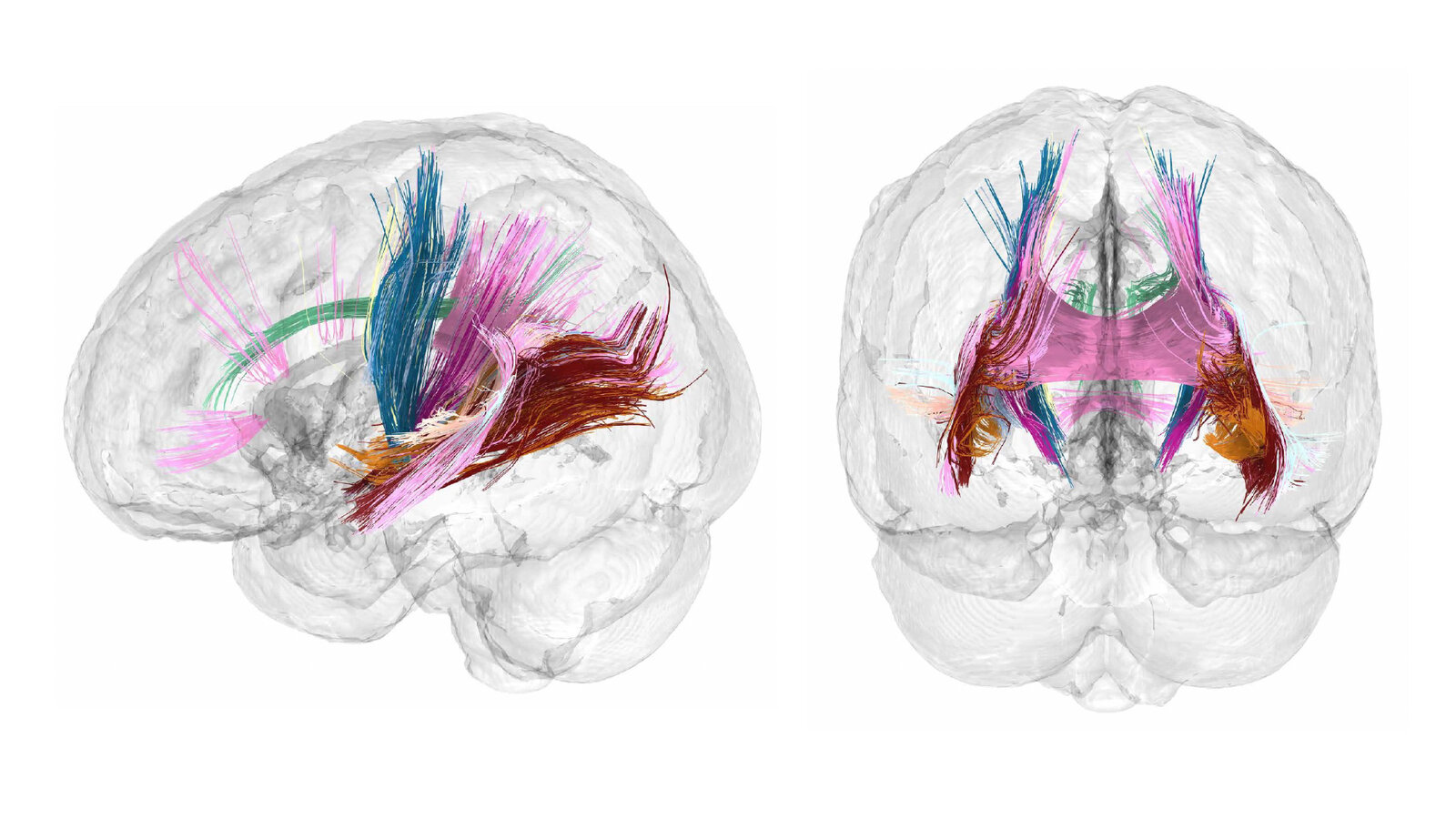
The Hoekzema et al. (2017) study, published in Nature Neuroscience, found that pregnancy produces brain changes so distinct a computer algorithm could sort women by whether they had given birth — and those changes persisted at six years postpartum. When researchers compared the brain scans of new mothers to those of teenage girls, the structural patterns looked strikingly similar. In adolescents, we call this adaptive maturation. In mothers, we call it "losing your edge." The science says otherwise.
And here's something the research has found that almost nobody is talking about yet: these brain changes may offer long-term benefits that extend well beyond early motherhood. Orchard et al. (2023), publishing in PNAS, found that mothers with more children show patterns opposite to age-related cognitive decline — pointing to the possibility that motherhood confers a form of functional neuroprotection across the lifespan. The brain you're worried about losing may actually be growing in ways we're only beginning to understand.
Your Identity Shifts at the Root
Matrescence is not just an emotional adjustment period. It is an identity-level reorganization. The values, priorities, relationships, and definitions of success and self-worth that you built your entire pre-mother life around are now up for renegotiation. Sometimes that feels like freedom. Often it feels like grief. Usually it feels like both at the same time, which ultimately is… confusing.
Amy Taylor-Kabbaz maps this through seven domains of life touched by this transition: physical, hormonal, emotional, social, cultural, economic, and spiritual. Across all seven, something shifts. Everyone has their own unique matrescence blueprint so the shifts will not be the same from mother to mother. Some may experience tectonic shifts in some areas, but only minor shifts in other areas. Acknowledging the shifts you experience across the domains is a good start in navigating this new version of you. When you feel like nothing in your life is the same, you're not being dramatic. You're being accurate.
The Stories You Didn't Know You Were Carrying
Part of what matrescence surfaces are the stories you didn't know you were carrying. A set of deeply internalized ideas about what a good mother looks and what a successful woman looks like — how she feels, what she sacrifices, how instinctively she should take to all of this, how she navigates her career — that you absorbed long before you became one.
Most women experience this as personal failure. Matrescence reframes it differently: the stories you were given about what motherhood should look like and what a successful woman looks like were built by a culture that had its own reasons for defining motherhood the way it did. The work is not closing the gap between yourself and the ideal. It's examining the ideal itself.
Is What I'm Feeling Matrescence — or Is It Something More Serious?
Matrescence is a universal developmental transition every mother goes through. Postpartum depression is a clinical condition affecting roughly 1 in 5 mothers (Postpartum Support International). They are not the same — but both can be happening at the same time.
Matrescence and postpartum depression (PPD) are not the same thing, and understanding the difference matters. Matrescence is a universal developmental transition — every woman who becomes a mother goes through some form of it. The disorientation, the ambivalence, the grief, the sense of not recognizing yourself — these are features of the passage, not necessary signs that something has gone wrong.
Postpartum depression is a clinical condition that requires clinical support. It is one of the most recognized conditions in a broader category of clinical conditions called perinatal mood and anxiety disorders (PMADs). And if you're a high-achieving woman who has always powered through hard things, you may not even recognize what you're experiencing as clinical — because it doesn't always look like depression. It shows up differently and more severely: persistent low mood, inability to feel connected to your baby, thoughts of harming yourself or your baby, a flatness or darkness that doesn't lift. If any of that resonates, please reach out to your doctor or a perinatal mental health professional. Postpartum Support International offers a helpline at 1-800-944-4773.
Here's how they differ at a glance:
| Dimension | Matrescence | Postpartum Depression |
|---|---|---|
| What it is | Developmental transition | Clinical condition |
| Who experiences it | Every mother (universal) | Approximately 1 in 5 mothers |
| Core experience | Identity reorganization, ambivalence, grief + joy | Persistent low mood, disconnection, darkness |
| Duration | Years-long, ongoing, recurs with each child | Episodes; treatable with clinical support |
| Onset | Begins during pregnancy, continues through motherhood | Can begin during pregnancy; most common at 2–8 weeks postpartum but can emerge anytime in the first year and beyond. Now understood as multiple onset patterns, not a single window. |
| Appropriate support | Coaching, community, frameworks, self-compassion, journaling | Therapy, medication, clinical care |
| Key distinction | A passage to move through | A condition to treat |
Here's where it gets complicated: both can be happening at once. A woman can be going through matrescence and experiencing postpartum anxiety or depression simultaneously. I know this from my own experience — I became a mother two months into the COVID pandemic, and it took me years to understand that the postpartum anxiety I was living with was a distinct layer on top of the identity transition I was also navigating. Having language for matrescence helped enormously. But it didn't replace the clinical support I also needed.
It's worth knowing that our understanding of when postpartum depression (PPD) begins has shifted significantly. It's no longer considered a "first six weeks" condition. Emerging research identifies distinct onset patterns — early episodes driven by the hormonal crash, mid-range episodes tied to cumulative depletion, and later episodes connected to identity shifts, return to work, and chronic isolation. That last category is where matrescence and clinical conditions most often overlap, and where women are least likely to be screened.
If you're unsure if your experience signals postpartum depression or another perinatal mood and anxiety disorder, please talk to your healthcare provider. Matrescence is a useful framework that can support you as you navigate your journey, but it does not replace proper clinical care that is needed for a clinical diagnosis. There are also a growing number of online maternal mental health clinics and providers, like Mavida Health, that are specialized in supporting women and their partners through postpartum depression and other maternal mental health conditions.
Why Does Becoming a Mother Feel Like Losing Yourself?
Because in some ways, you are losing your former self. And that part is real, and it's allowed to be hard.
Matrescence asks you to hold two things simultaneously: the expansion of becoming a mother, and the loss of the person you were before. We are more comfortable welcoming the expansion. What we don't have is language for the grief. The mourning of your pre-mother self. Or the ambivalence of holding multiple contrasting feelings at the same time. The specific disorientation of looking in the mirror and not quite recognizing the woman looking back.
The research on maternal identity actually gives us a map for this process. What the studies show is that this isn't one single rupture but a sequence: there's the preparation phase, where you begin mentally making room for change even before your baby arrives. Then the emotional labor of bringing new parts of yourself forward. Then integration, where you begin the slow work of reconciling who you were with who you are becoming. Then reconfiguration — repositioning your identity within a completely changed context. And then an ongoing evolution that continues across the whole arc of mothering.
Knowing you're in a stage, rather than completely lost in a feeling, can help you move through it.
Every culture in human history has built ceremony around transitions like this one, and anthropologist Arnold van Gennep showed us why. His mapping of rites of passage across dozens of cultures found the same three-phase structure every time: you separate from your old identity, you enter a liminal phase — the crossing itself — and eventually you incorporate a new one. He saw childbirth as one of these universal passages. What he also showed is that cultures build ritual containers around these crossings because without them, the crossing stalls.
Victor Turner, building on van Gennep's work, described people in the liminal phase as "neither here nor there" — unable to fully release who they were, unable to fully inhabit who they're becoming. The liminal phase asks something specific of the people inside it: the willingness to sit with not-knowing. To release the old story before the new one is ready.
For high-achieving women, this is often the hardest part — not the transformation itself, but the uncertainty inherent in crossing the threshold.
Modern Western culture has stripped almost all ritual from the transition into motherhood. We have baby showers, which celebrate the baby's arrival beautifully. We have almost nothing that witnesses the mother's passage (though rituals like Mother Blessing ceremonies and Mother Warmings are slowly making their way back into modern lives, but I'd still consider these a bit fringe). Is it any wonder so many of us get stuck in the threshold?
Much of the transformation occurs in letting go of old ways of being. In those early months postpartum I had a lot of work to do around letting go of the achievement-oriented self, the need to accomplish as much as I did before motherhood to feel valuable. The assumption that asking for help was weak. The attachment to having everything figured out.
This is the work of matrescence. Slowly and steadily unraveling the narratives about who you're supposed to be in motherhood and inching closer and closer to the true you that is unfolding.
How Long Does Matrescence Last?
Matrescence is not a postpartum phase with a set endpoint. It is a years-long developmental process that recurs with each child and evolves across the full arc of motherhood.
Matrescence doesn't end at six weeks, or three months, or even a year. Research and clinical experience both suggest it is a years-long process, and for many women, you may come to view it as a lifelong unfolding as you move through the different seasons of motherhood. It doesn't follow a linear timeline. You can feel like you've found your footing, then a new developmental stage in your child's life, a return to work, or a shift in your relationship can crack you open all over again.
It's also worth naming something that almost no popular content acknowledges: matrescence recurs with each child. Dr. Aurelie Athan's definition explicitly recognizes this. If you are on your second or third baby and you feel like you're back at the beginning — disoriented, uncertain, not quite yourself — you're not failing to have learned from the last time. You are going through matrescence again, in a new form, with a new child, in a new chapter of your own identity. This is expected. This is normal. And it means the work of integration is not a one-time event but a living practice.
What changes with time and support is not the complexity of the transition, but your relationship to it. You stop waiting to get back to who you were before and start getting curious about who you're becoming instead.
Matrescence Is Not a Problem to Solve
We are used to solving problems. Especially in the uncomfortable liminal stage of moving from one identity to the other, our instinct is to fix, control, systemize, and optimize.
You may have spent your whole life solving problems, but perhaps the biggest reframe you can embody on this journey is the fact that matrescence is not a problem to solve. It is not something to "bounce back" from. Your brain isn't declining — it is restructuring in ways comparable to the most significant developmental stage of your youth. Your identity isn't broken — it is reorganizing to make room for a version of yourself that didn't exist before. As William Bridges writes about life transitions: renewal happens when we're willing to let go of something we were attached to and follow where life is pointing instead.
Matrescence is that invitation.
The dominant narrative — get your body back, get your career back, get your life back — is not just unhelpful. It's neurologically inaccurate. Your brain doesn't revert to its pre-pregnancy state. Your identity doesn't snap back like a rubber band. And the research that documented brain changes persisting six years postpartum suggests that what happened to you is permanent in the most beautiful sense: you are genuinely different now. Not less. Different.
So instead of solving your way through this, consider a different frame: What if this isn't something to fix, but something to move through? What if the disorientation is the passage, not the problem?
So — What Do We Actually Do With All of This?
Here is what I think is the biggest gap in the matrescence conversation right now.
The research has done extraordinary work documenting what changes during this transition. The neuroscience, the identity shifts, the hormonal cascade, the relational reorganization. All of this is essential. The documentation is the foundation. It's what lets a woman say: something real is happening to me, and I'm not broken.
But the documentation doesn't tell her what to do on a Tuesday morning when she hasn't slept, her toddler is melting down, she has a work deadline, and she feels like a stranger in her own life. When she has hit the overwhelm-and-burnout cycle yet again after trying to manage life in a world not set up to support her.
The "what now?" is almost entirely absent from what's available in the academic literature and in much of the standard online motherhood content.
This is where my coaching work comes in. And it's why, after years of working with mothers through this transition, I developed a framework I call The Matrescence Threshold™ — built around three stages that move women through the identity crossing of matrescence.
The Matrescence Threshold™
In anthropology, a threshold is the crossing point between one state of being and another — the space where you are no longer who you were but not yet who you're becoming. William Bridges, whose transition model has shaped how we understand major life changes for over forty years, described three phases that every significant transition moves through: an ending, a neutral zone, and a new beginning. A mother in one of his earliest seminars put it in terms that captured what I felt in my bones: "I've crossed some kind of threshold and there's no going back." That's matrescence. And The Matrescence Threshold™ framework — Restore, Redefine, Redesign — is built on that same developmental arc, adapted for the specific, layered reality of modern motherhood. It is not a prescriptive path. It is a map for a passage that every mother is already on — whether she has language for it yet or not.
Restore
Restore is the first stage — and it has to come first. You cannot redefine your values or redesign your life when your body, nervous system, and spirit are depleted. Restore is about tending to yourself at the most fundamental level: sleep, nourishment, nervous system regulation, the practices that help you come back to yourself when the demands of early motherhood have taken you so far from yourself you can barely locate who you are. This stage is relevant in those acute early postpartum months — but it also recurs whenever life throws you back into survival mode.
Redefine
Redefine is the deeper identity work. Redefining your values, your definition of success, your relationship to work and ambition, your understanding of what a "good mother" actually looks like (spoiler: it's almost certainly more generous than the one you were holding yourself to). Redefining what you owe to others and what you owe to yourself. This is the stage where the Funfetti cake box moment gets examined — not with self-criticism, but with genuine curiosity about what story you were living inside, and whether you want to keep living there. More often than not, this is where you confront generational patterns of overgiving, perfectionism, or low self-worth.
Redesign
Redesign is where the insights become real changes. Redesigning your daily rhythms, your work setup, the structure of the support system around you (or lack thereof), the relationships that need renegotiating, the commitments that no longer fit who you're becoming. This is the practical application of the prior two stages. It is an ongoing, living adjustment to a life that keeps evolving.
Where Do You Start?
Understanding the concept is the first step. And if you've read this far, you've already taken it.
However you got here, know this: the fact that you're looking for language means something is already shifting. Naming it doesn't fix it. But it changes your relationship to it. You stop pathologizing yourself. You stop asking what's wrong with me and start asking what's happening to me — and that is world changing in and of itself.
The anthropologist Victor Turner identified something he called communitas — the unusually deep bonds that form between people navigating the same liminal passage together. Something about the threshold dissolves the normal social hierarchies; people meet each other as equals in transformation. This is one of the reasons I structure my group work the way I do. It's also one of the reasons why new motherhood community groups that are structured for intimacy and true connection make such a difference to maternal wellbeing (Mysha is a membership community with an intimate birth pod and location based pod model that does this particularly well). There is something that happens in a room — or a virtual room — of mothers who are all in the crossing at the same time. It is something humans have always needed at moments like this. It's only in recent history, here in the West, where we've lost this way of being together through life's thresholds.
You don't have to cross this threshold alone.
Ready for something deeper?
The word matrescence has a way of arriving exactly when a woman is ready for it. Sometimes in the acute blur of the fourth trimester. Sometimes years into motherhood, when the fog has lifted enough to finally look around and take stock. Sometimes when you've been struggling for months and couldn't quite name why.
Whenever it arrives for you, know that it did in the exact right timing.
Matrescence Missives is my weekly newsletter where I think out loud about all of this: the identity shifts, the impossible decisions, the overwhelming joy, the practical realities of mothering in this particular cultural moment. It's where I share what I've learned from my own experience, from the research I'm steeped in, and from working alongside mothers who are in the thick of their own becoming.
If this resonates, I'd love to meet you there. Subscribe to receive it in your inbox.
Matrescence Coaching Offerings If you're past the awareness stage and into the okay, what do I actually do with this stage, I work with women in the early years of motherhood who are navigating The Matrescence Threshold™ individually and in small groups.
In the coaching work I do with mothers — in private sessions, small group cohorts, and workshops — I almost always start in the same place: with what I think of as the birth of the mother, separate from the birth of the baby. We track every milestone for our children and almost none for ourselves. That absence has a cost.
Some of the questions I bring to this work at the start of a container:
- Where have you experienced the most significant shift since becoming a mother?
- What area of your life is feeling the stickiest right now?
- What has been falling away — and what, if you pay close attention, is starting to take root?
These questions are a form of inventory — a way of beginning to see the terrain of your own matrescence clearly, across multiple life domains, from a place of self-compassion rather than self-criticism.
When we deeply acknowledge the weight of this transition, we begin to value our experience differently. When we value our experience differently, we begin to treat ourselves differently. When we treat ourselves differently, the world around us begins to follow suit.
Group cohort dates, workshops, and events are announced first to my email list — sign up to receive updates and newsletter-only discounts here.
With you through the in-between, Lauren
Frequently Asked Questions About Matrescence
What is matrescence and why does it matter?
Matrescence is the psychological, biological, neurological, emotional, social, and spiritual developmental transition every woman undergoes when she becomes a mother. It is universal (every mother experiences some form of it), comparable to adolescence in scope, multi-dimensional (affecting physical, emotional, identity, social, cultural, economic, and spiritual domains), and developmental — not pathological. For generations, women moved through this transformation without a word for it — and without language, the only available explanation was something is wrong with me. Dr. Aurelie Athan, who revived the term at Columbia, says it simply: "words create worlds." Naming matrescence moves the experience from pathology to passage.
What does matrescence actually feel like?
Matrescence is not a clinical diagnosis, so these aren't symptoms — they're recognizable features that many mothers experience as part of the major developmental transition:
- Identity disorientation — Feeling like you don't recognize yourself or don't know who you are anymore
- Simultaneous grief and joy — Mourning your pre-mother self while loving your baby
- Value shifts — What mattered before no longer seems to matter in the same way
- Relationship changes — Partnerships, friendships, and family dynamics reorganize
- Ambivalence — Not feeling the pure, uncomplicated joy you expected or having conflicting feelings about the experience
- Overwhelm that is more than just "being busy" — A sense of being flooded that goes beyond your to-do list, as if your nervous system is processing more than it was built for
- The push and pull of career — Wanting to return to work and wanting to stay home, sometimes in the same hour — and feeling guilty about both
- Self-criticism and holding yourself to impossible standards — Measuring yourself against a version of motherhood that doesn't exist and coming up short every time
- The liminal feeling — Being suspended between who you were and who you're becoming
These are not signs that something is wrong. They are predictable features of a major developmental transition.
Where did the word matrescence come from?
Medical anthropologist Dana Raphael coined the term "matrescence" in 1973 in her published work The Tender Gift: Breastfeeding. She is also the scholar who coined the word "doula." Dr. Aurelie Athan at Columbia University later revived and expanded the term into a developmental framework, and Dr. Alexandra Sacks brought it into broader public awareness through her article and TED talk.
Is what I'm feeling matrescence or postpartum depression?
Matrescence and postpartum depression are not the same thing. Matrescence is a universal developmental transition — every woman who becomes a mother experiences their own unique version of it. Postpartum depression is a clinical condition affecting roughly 1 in 5 mothers that requires clinical care. It is one of the more recognized diagnoses in a group of clinical conditions known as PMADs, perinatal mood and anxiety disorders. The two can overlap — women may experience both simultaneously. Having language for matrescence helps, but it does not replace clinical support if that is what is needed. If you are experiencing persistent low mood, disconnection from your baby, or thoughts of self-harm, please speak with your healthcare provider right away. Postpartum Support International has a directory of professionals and offers a helpline at 1-800-944-4773. There are also a growing number of online maternal mental health clinics and providers, like Mavida Health that are specialized in supporting women and their partners through postpartum depression and other maternal mental health conditions.
What happens to your brain when you become a mother?
Pregnancy produces pronounced changes in brain structure — gray matter reorganizes in regions linked to social cognition, empathy, and threat detection. The Hoekzema et al. (2017) study found these changes are comparable to adolescent brain development and persist for at least six years postpartum. Emerging research suggests motherhood may confer neuroprotective benefits later in life (Orchard et al., 2023). This is not cognitive decline — it is neural restructuring for a new developmental stage.
How long does matrescence last and does it ever end?
Matrescence is not a postpartum phase with a fixed endpoint. It is a years-long developmental process that continues to evolve across motherhood. It recurs with each child. What changes with time and support is not the transition itself but your relationship to it.
Do you go through matrescence again with a second or third baby?
Yes. Dr. Aurelie Athan's definition explicitly recognizes that matrescence recurs with each child. Each baby brings its own version of the transition — a new identity reorganization, new losses, new becoming. If you find yourself back in that disoriented feeling with your second or third child, that is not regression. That is matrescence again, in a new form.
Can fathers or non-birthing parents experience matrescence?
Research suggests yes. Studies have found that brain changes associated with caregiving appear in non-birthing parents too — including fathers and adoptive parents who take on primary caregiving roles. The key variable appears to be hands-on caregiving time, not biology alone. While matrescence as a term is rooted in women's experience of becoming mothers, the identity disruption of parenthood extends beyond the birthing parent. "Patrescence" is an emerging area of research.
What does a matrescence coach do and how is it different from therapy?
A matrescence coach helps you understand and navigate the identity transition of motherhood — naming what's shifting, making sense of the variety of feelings and experiences, and building a sense of self that integrates who you were with who you're becoming. It is not therapy (a matrescence coach doesn't address clinical mental health conditions) and it's not generic life coaching. It is specialized support at the intersection of identity change, personal transformation, and life pivots — all through the lens of matrescence as a developmental passage. Lauren Smith-Pierson, a certified matrescence coach and founder of Simply Matrescence, uses The Matrescence Threshold™ framework to guide mothers through this process in three seasons: Restore, Redefine, and Redesign.
Sources & Further Reading
- Raphael, D. (1973). The Tender Gift: Breastfeeding. Schocken Books.
- Athan, A. (2016–present). Matrescence research. Teachers College, Columbia University.
- Sacks, A. (2017). A new way to think about the transition to motherhood. TED Talk.
- Conaboy, C. (2022). Mother Brain: How Neuroscience Is Rewriting the Story of Parenthood. Henry Holt & Co.
- Taylor-Kabbaz, A. (2021). Mama Rising: Discovering the New You Through Motherhood. Hay House.
- Jones, L. (2023). Matrescence: On Pregnancy, Childbirth, and Motherhood. Allen Lane.
- Rich, A. (1976). Of Woman Born: Motherhood as Experience and Institution. W.W. Norton.
- Bridges, W. & Bridges, S. (2019). Transitions: Making Sense of Life's Changes. Da Capo Press.
- van Gennep, A. (1909/1960). The Rites of Passage. University of Chicago Press.
- Turner, V. (1969). The Ritual Process: Structure and Anti-Structure. Aldine.
- Hoekzema, E., et al. (2017). Pregnancy leads to long-lasting changes in human brain structure. Nature Neuroscience, 20(2), 287–296.
- Orchard, E.R., et al. (2023). Neuroprotective effects of motherhood on brain function in late life. PNAS, 120(4).
- A critical need for the concept of matrescence in perinatal psychiatry — PubMed.
Matrescence Missives
Seasonal essays on identity, ambition, and the architecture of becoming a mother. For the woman in the threshold.